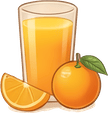
- Default serving200 ml6.8 fl oz · Juice
- Counts toward goal200 mlthe full serving
- Hydration factor1.10raises the hydration level more than water
- Calories90 kcal45 kcal per 100 ml
Move the slider to see what a bigger or smaller orange juice does to the numbers. The app uses the same figures.
Work out your daily drinking target with the water intake calculator.
The trial result
Orange juice was one of 13 drinks in the Beverage Hydration Index trial. Each of 72 men drank a litre (34 fl oz) of still water and, on separate days, a litre each of three other drinks, and their urine was collected for four hours. Over the four hours, the urine after orange juice was no different from the urine after water. Only an oral rehydration solution, full-fat milk and skimmed milk did better. (Maughan et al., 2016)
The orange juice in the trial was 89% water, with 10.5 g of carbohydrate per 100 ml, plenty of potassium (33 mmol per litre) and almost no sodium (1 mmol per litre). (Rodriguez-Sanchez, 2016) Its potassium did not make it better than water over four hours.
A small lead at two hours
A thesis by one of the trial's authors reports more detail. Two hours after drinking, the men had passed less urine after orange juice than after water. Once the researchers allowed for the juice's lower water content, its two-hour score was about 1.24 against water's 1.00, a gap the trial could not separate from chance. (Rodriguez-Sanchez, 2016)
The sugar likely explains the lead. In a follow-up trial, drinks with 10% sugar produced less urine than plain water, probably because the energy slows how fast the water reaches the blood. (Maughan et al., 2019) Orange juice is about 10% carbohydrate.
How it counts
WaterChamp gives orange juice a hydration factor of 1.10. The trial found no clear difference from water, so 1.10 is an estimate, between water's 1.00 and the two-hour figure above. The glass counts in full toward your goal either way; the factor changes only how far it moves the live hydration level. Apple, grape and berry juice sit at 1.05, also as estimates.
The sugar
The WHO counts the sugar in fruit juice as free sugar, the kind it recommends keeping below 10% of daily energy and ideally below 5%, about 25 g a day. (WHO, 2015) A 200 ml glass of juice like the one in the trial carries about 21 g of carbohydrate, most of it sugar.
Questions
Does orange juice count as water intake?
Yes. A glass counts in full toward your daily water goal.
Does orange juice dehydrate you?
No. In the trial it hydrated as well as still water.
Is orange juice good when you are dehydrated?
It hydrates about as well as water. The best drink in the trial was an oral rehydration solution, at 1.54.
How much sugar is in a glass of orange juice?
A 200 ml (7 fl oz) glass like the one in the trial has about 21 g of carbohydrate, most of it sugar.
Hydration factors follow the Beverage Hydration Index: Maughan RJ, Watson P, Cordery PA, et al. “A randomized trial to assess the potential of different beverages to affect hydration status: development of a beverage hydration index.” American Journal of Clinical Nutrition, 2016;103(3):717-723. Read the paper on PubMed. In WaterChamp an orange juice raises the hydration level slightly more than plain water.